How Often Should You Run Evacuation Drills? Australian Compliance Requirements
Understand Australian evacuation drill frequency requirements. Learn when to run announced vs unannounced drills and how to maintain readiness between exercises.
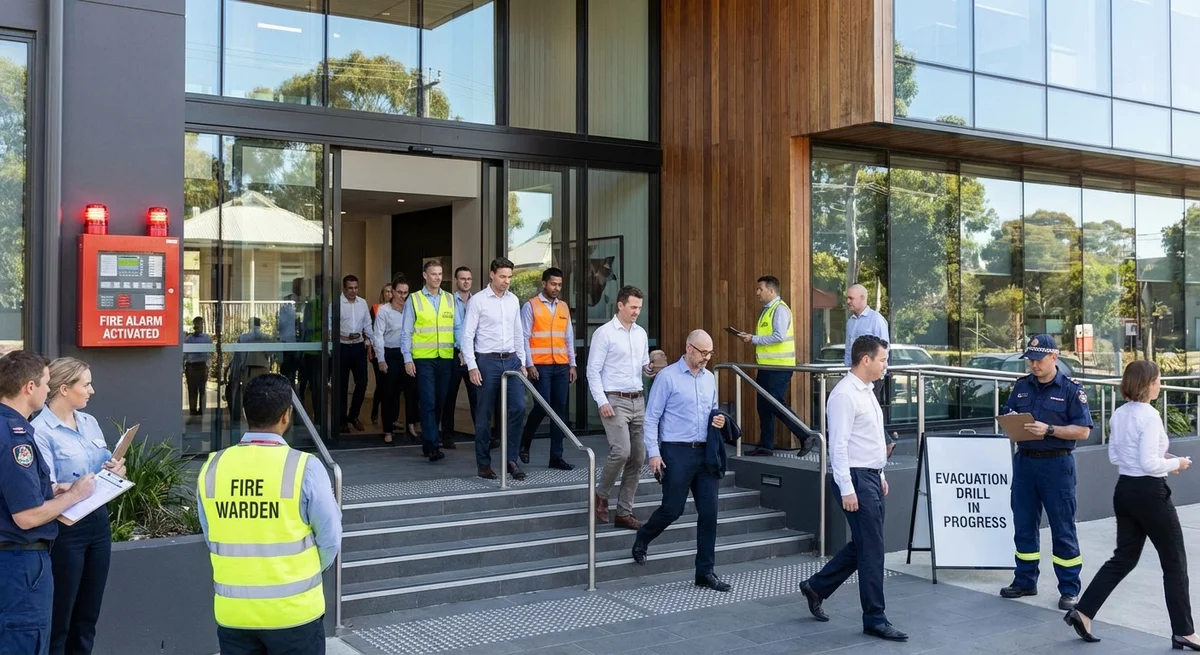
What AS 3745 Says About Evacuation Exercise Frequency
The Australian Standard AS 3745 (Planning for emergencies in facilities) provides the framework for evacuation exercises in Australian workplaces. Understanding these requirements helps you maintain compliance while building genuine emergency capability.
The Basic Requirement
AS 3745 requires that evacuation exercises be conducted at intervals not exceeding 12 months. This means every facility must conduct at least one full evacuation exercise per year.
However, this is a minimum requirement, not a target. Many workplaces benefit from more frequent exercises.
First-Year Requirements
For newly occupied facilities or when significant changes occur (new tenants, major renovations, changed use), AS 3745 recommends the first exercise be conducted within three months of occupation or change, with follow-up exercises at six months and twelve months.
This accelerated schedule helps establish emergency response capability when everything is new.
State-Specific WHS Requirements
While AS 3745 provides the standard framework, Work Health and Safety legislation in each state and territory creates legal obligations for emergency preparedness.
General WHS Obligations
All Australian WHS laws require employers to ensure, so far as reasonably practicable, the health and safety of workers. This includes having appropriate Emergency Management Plans and ensuring workers are trained and prepared.
While the legislation doesn’t specify exact drill frequencies, demonstrating compliance typically requires following AS 3745 requirements, documenting all exercises and outcomes, and maintaining training currency.
High-Risk Industries
Some industries have specific requirements. Healthcare facilities, aged care, and childcare centres often face additional regulatory requirements for emergency exercises beyond the standard AS 3745 minimums.
Factors That May Require More Frequent Drills
High Staff Turnover
If your workplace experiences significant staff turnover, annual exercises may leave many staff having never participated in a drill. Consider more frequent exercises when turnover exceeds 20-30% annually, new staff regularly miss scheduled exercises, or there’s a pattern of unfamiliarity during exercises.
Complex or High-Risk Facilities
Some facilities warrant more frequent practice including multi-storey buildings with complex evacuation procedures, facilities with mobility-impaired occupants, high-occupancy venues (shopping centres, entertainment venues), facilities with hazardous materials, and 24/7 operations where all shifts need practice.
After Significant Changes
Schedule additional exercises when you move to a new building or floor, make significant changes to floor layouts, have major changes to warden teams, update emergency procedures substantially, or experience a real emergency that revealed issues.
Poor Exercise Performance
If evacuation exercises reveal significant problems—slow evacuation times, warden confusion, poor accountability—additional exercises may be needed to achieve acceptable performance.
Announced vs Unannounced Drills
Announced Drills
Most evacuation exercises are announced, meaning staff know in advance that an exercise will occur (though perhaps not the exact time).
Advantages of announced drills:
- Allows wardens to prepare and be present
- Reduces anxiety for staff
- Enables coordination with building management and neighbours
- Allows for observers and detailed evaluation
Appropriate for:
- Initial exercises in new facilities
- Testing new procedures
- Training new warden teams
- Complex facilities requiring coordination
Unannounced Drills
Unannounced (or surprise) exercises test genuine readiness without preparation time.
Advantages of unannounced drills:
- Tests real-world response capability
- Identifies gaps in warden coverage
- Reveals staff knowledge levels
- More realistic timing data
Considerations:
- May need to inform building management (for fire alarm activation)
- Should not be the first exercise for a new team
- May cause more disruption to operations
- Best used after announced exercises establish baseline capability
A Balanced Approach
Consider alternating between announced and unannounced exercises. For example, with semi-annual exercises, one announced (for training and detailed evaluation) and one unannounced (for realistic testing).
What to Do Between Drills
Maintaining Readiness
Evacuation capability shouldn’t only be tested during formal exercises. Between drills:
Monthly:
- Confirm warden availability and coverage
- Check exit routes are clear
- Verify emergency equipment is accessible
- Update contact lists as needed
Quarterly:
- Review and refresh warden knowledge
- Brief new staff on emergency procedures
- Check assembly point arrangements
- Review any changes affecting evacuation
Ongoing:
- Include emergency procedures in new staff inductions
- Address hazards and obstructions immediately
- Keep Emergency Management Plans current
- Maintain training records
Our compliance administration service can help manage these ongoing requirements.
Common Mistakes with Drill Scheduling
Mistake 1: Only Meeting Minimums
Annual exercises barely maintain compliance and don’t build strong capability. Consider whether your facility’s risk profile warrants more frequent practice.
Mistake 2: Always the Same Scenario
If every drill follows the same pattern (same time of day, same scenario, same alarm), you’re testing a narrow range of capability. Vary your exercises to test different scenarios.
Mistake 3: Scheduling Around Convenience
Drills scheduled only when everyone is present and prepared don’t test realistic scenarios. Include exercises during different shifts, busy periods, and with key personnel absent.
Mistake 4: Skipping the Debrief
Exercises without thorough debriefs waste the learning opportunity. Always conduct hot and cold debriefs to capture observations and drive improvements.
Mistake 5: Not Documenting Outcomes
Every exercise should generate documentation including date, time, scenario, participants, evacuation time, observations, and improvement actions. This documentation demonstrates compliance and tracks progress.
How Messana Group Can Help
With over 25 years of experience facilitating evacuation exercises across Australia, Messana Group provides:
- Professionally facilitated exercises with realistic scenarios
- Objective observation and evaluation of warden and staff performance
- Comprehensive debrief facilitation to capture learnings
- Detailed exercise reports with actionable recommendations
- Ongoing compliance administration to maintain readiness
Next Steps
Schedule your next professionally facilitated evacuation exercise with Messana Group, or call 1300 622 030 to discuss your exercise requirements.
Related Services
Need Help With Emergency Management?
Contact us for a free compliance assessment and discover how we can help your organisation.